1921: 1,260 people in 207 houses
1921: 207 வீடுகளில் 1,260 பேர்
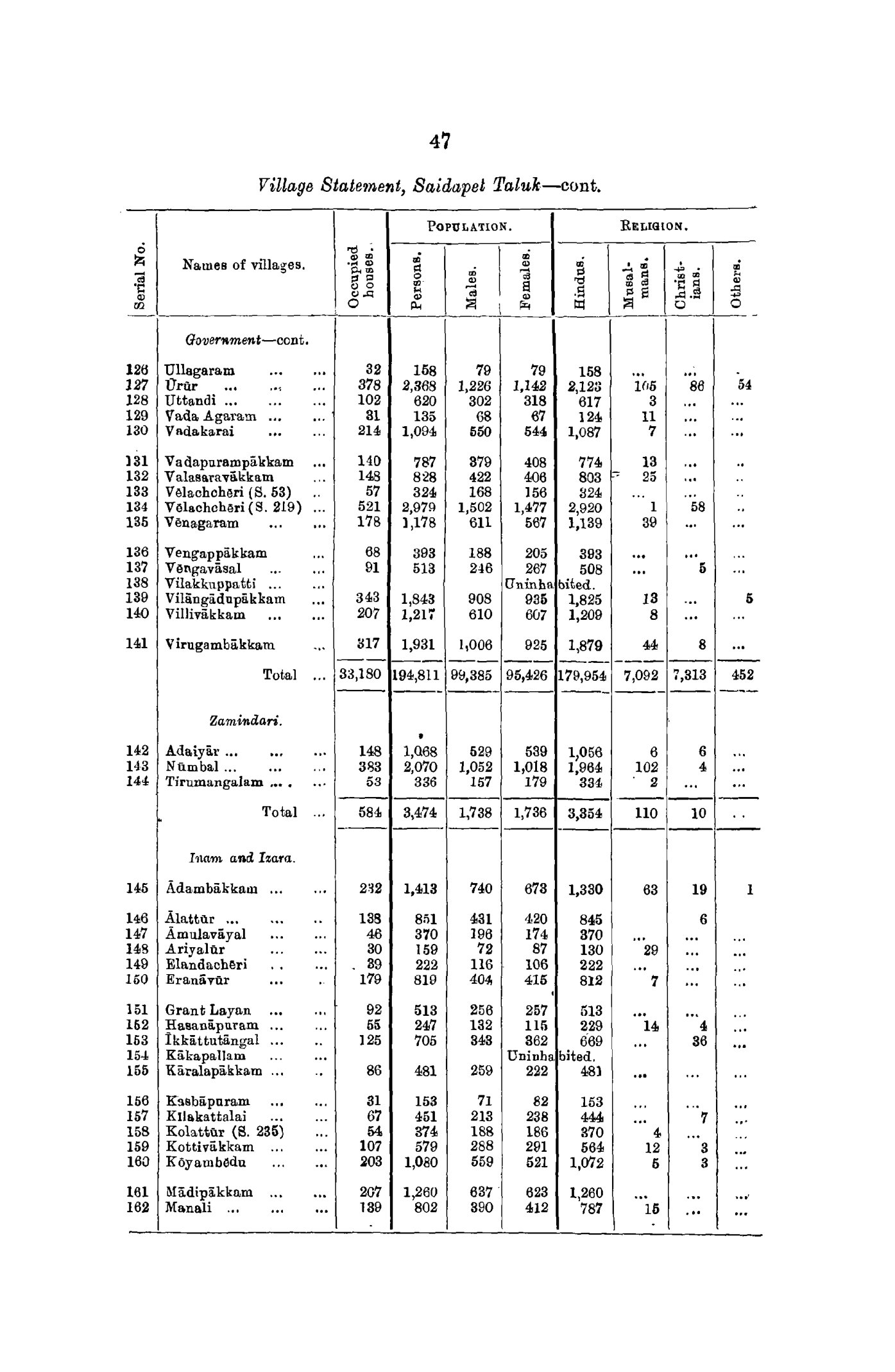
The 1921 census printed a village table for Chingleput district. Entry 161 in Saidapet taluk is 'Mādipākkam', with 207 occupied houses and 1,260 people, all of them Hindus.
- Population
- 1,260 (637 men, 623 women)
- Occupied houses
- 207
- Religion
- 1,260 Hindus; no Muslims or Christians
- Entry
- No. 161, Saidapet taluk, under 'Inam and Izara'
- Record
- Census of 1921: Village Statistics, Chingleput District (printed 1922)
- Held at
- Census of India digital library (censusindia.gov.in)
- Page
- 47
What the record says
After the census of 1921, the Government Press at Madras printed a book of village figures for Chingleput district. It came out in 1922.
For each taluk, the villages are grouped by how the land was held. First come 'Government' villages, then 'Zamindari', then 'Inam and Izara'. Madipakkam is in the last group, as entry 161. The name is printed 'Mādipākkam', with marks over the long vowels.
The row is short. It gives 207 occupied houses and 1,260 people: 637 males and 623 females. Under religion, all 1,260 are Hindus. The columns for Musalmans, Christians and others are empty.
Words to know
An occupied house is a house that had people living in it when the count was made.
A Government village was an ordinary village where each farmer paid land tax straight to the state. A zamindari was an estate held by a landlord. An inam was a grant of land or revenue on special terms. An izara was a lease: a person paid the government a fixed sum and collected the village revenue himself.
The line over a letter, as in 'Mādipākkam', shows a long vowel: Maa-di-paak-kam.
What it tells us about Madipakkam then
In the fifty years since 1871, the village grew from 744 people to 1,260. That is 516 more people, a rise of about 69 per cent. Houses went up from 91 to 207. There were now about 6 people to a house, against 8 in 1871. The two censuses may have counted houses in different ways, so this change should not be pressed too hard.
Men and women were almost equal in number. In 1871 the census found 15 Muslims here. In 1921 it found none.
The village was still listed among the inams, as it was in 1871, 1879 and 1913.
How it compares
Other inam villages on the same page include Adambakkam with 1,413 people, Koyambedu 1,080, Kottivakkam 579, Kilakattalai 451 and Kasbapuram 153. Higher up the page, among the Government villages, Velachcheri (survey no. 219) had 2,979.
So in 1921 Madipakkam was a mid-sized village for the area, a little smaller than Adambakkam.
About this record
We read the entry from the page image, and it matches our notes. This is the last village-level count we have found before 1951. We have not found village figures for Madipakkam from the 1931 or 1941 censuses.
Timeline
- 1871744 people in 91 houses.
- 1913The Gazette lists the village as a shrotriem (an inam).
- 19211,260 people in 207 occupied houses.
- 1922The village statistics book is printed.
- 1951The next count we have: 761 people.